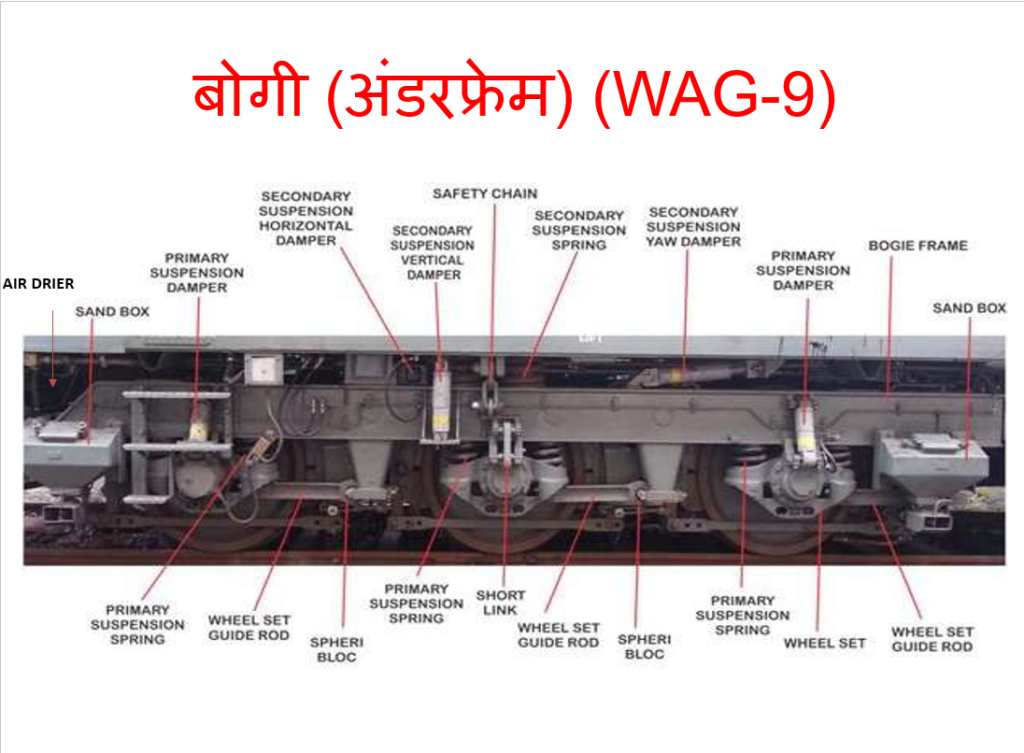
The most important part of train operation is underframe checking of an electric loco. It contains various components, including the cattle guard, traction motor, air reservoir, battery box, sand box, and cabling systems. Underframe checking is performed to ensure safety, reliability and efficient operation of the locomotive. During underframe checking, maintenance staff check the structure of the loco under parts, mounting arrangements, suspension system, piping, cables, and other equipment for damage, corrosion, looseness, or abnormalities.
When is underframe checking of Electric Loco carried out?
- While taking charge of the locomotive
- When the train is standing en route
- On receipt of a CRO (Caution/Complaint Report Order)
- At the time of troubleshooting
Key Points to Inspect
- Both side rail & cattle guards to be ensured without any damages/bents and intactness.
- Both side CBC to be ensured for no abnormality and locking pin is available. CBC to be checked by opening & closing (other than train side). Operating handle of CBC, if provided, is with safe condition.
- Ensure that both side MRE, BCE, BP & FP hoses are connected properly and their angle cocks are as per requirement. Also ensure, hoses are not hanging & are secured in hooks meant for these.
- Operation of leading side BP & FP angle cocks to be ensured proper, if there is any mark of CRO.
- Ensure all UIC connector sockets are covered.
- Additional MR, BC, BP & FP additional cocks are in open position.
- Air drier is not bypassed (A & B cocks are opened, C cock is closed).
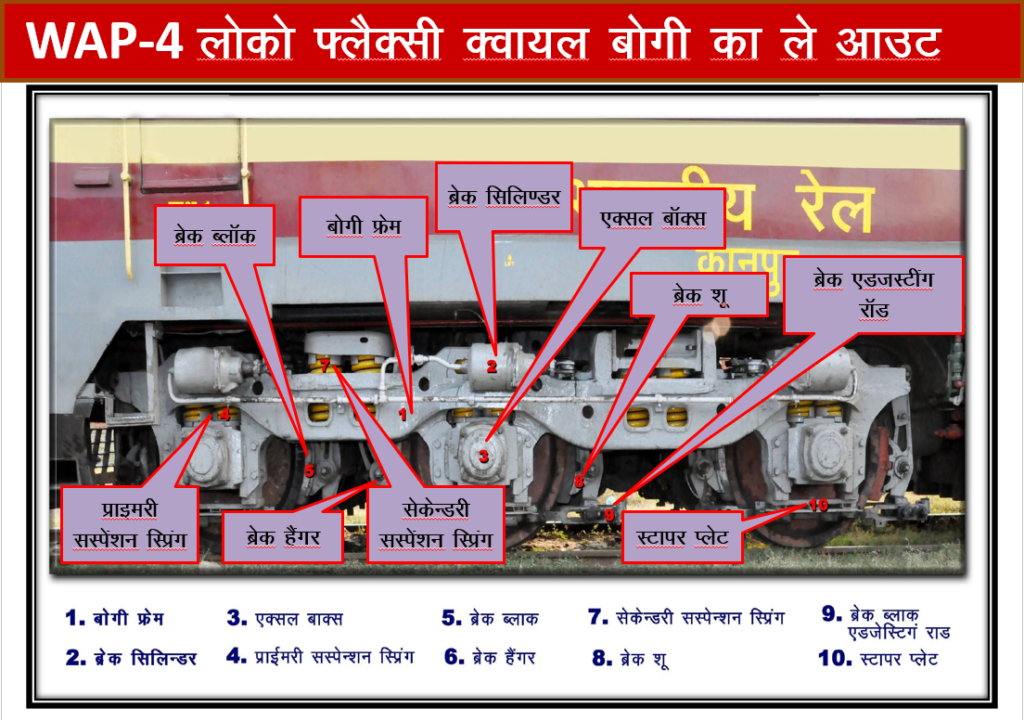
- Ensure all suspension dampers, springs having no abnormalities like crack.
- Wheel set guide rod is fitted properly & its bolts are tightened.
- All brake riggings, brake blocks, brake shoes, sleeve rod, and assembly hanger arrangements are okay.
- Return current bushes are connected properly.
- Parking brake cylinders, if provided, are fitted with a manual releaser hook.
- Traction links are fitted properly, and all 6+6 bolts are tightened.
- Lubrication oil of CPs is above the minimum mark, and their foundation bolts are tightened with the safety sling kept slack.
- Wheels are not skidded.
- Bogie cut-out cocks are in open condition.
- Battery box covers are closed and locked properly.
- Feeling of temperature of all axle boxes.
- Intactness of all TM nose suspension bolts, split pins, and their inspection covers.
- Any other item affecting the safe running of the locomotive.
Importance of Underframe Checking in Electric Locomotives
- Ensures the safe operation of the locomotive during service.
- Helps identify cracks, damages, and loose fittings in the underframe structure.
- Prevents unexpected equipment failures while running.
- Ensures proper functioning of brake rigging, brake blocks, and brake shoes.
- Verifies the condition of suspension springs, dampers, and traction links.
- Detects air leakage from brake pipes, feed pipes, and associated hoses.
- Ensures all CBCs, hoses, angle cocks, and safety devices are in proper condition.
- Helps maintain wheel and axle box health, reducing the risk of overheating and derailment.
- Confirms that battery boxes, cables, and electrical connections are secure and protected.
- Prevents operational delays by identifying defects before they become serious.
- Improves the reliability and availability of the locomotive.
- Reduces maintenance costs through early fault detection.
- Ensures compliance with Indian Railways safety standards and maintenance practices.
- Enhances braking efficiency, riding stability, and traction performance.
- Contributes to the safe and punctual movement of trains.
Check more articles on Underframe and more on Rankerbook