Introduction
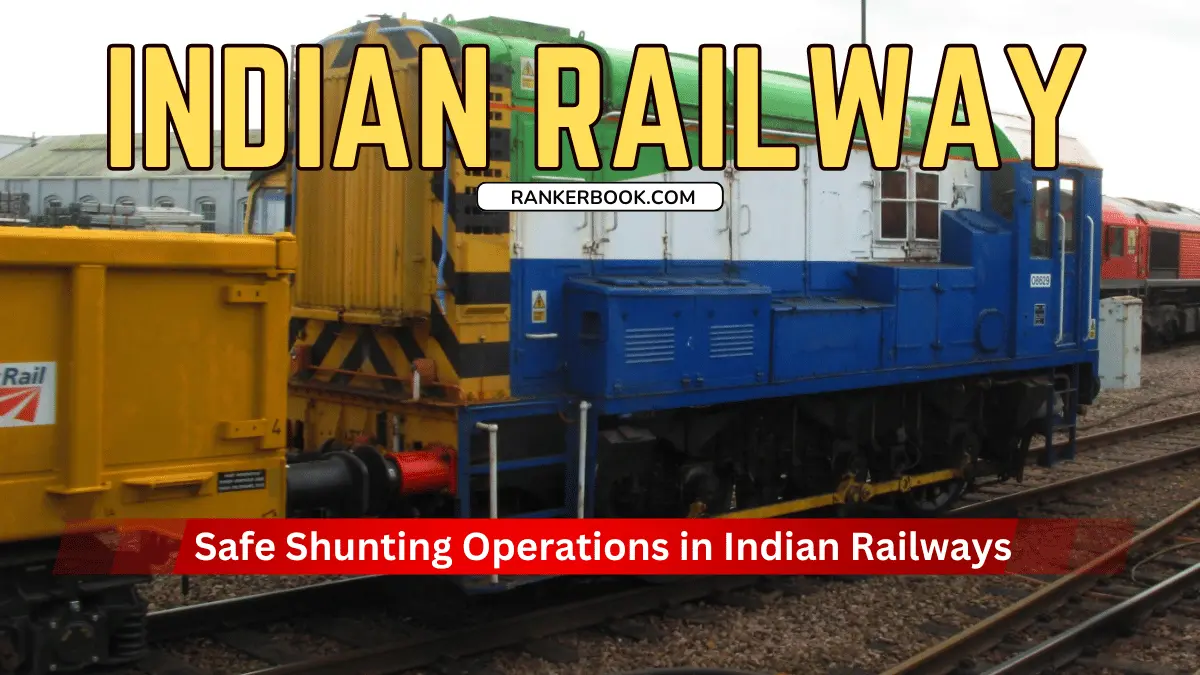
Safe Shunting Operations: Shunting is one of the most important railway operations in yards, locomotive sheds and pit lines. It involves the movement of locomotives, coaches or wagons from one track to another for maintenance, formation, stabling or operational purposes. As shunting activities are carried out in restricted areas with multiple tracks and moving vehicles, strict safety measures are essential to prevent accidents.
Unsafe shunting practices can cause derailments, side collisions, head-on collisions, roll-downs and Signal Passing at Danger (SPAD). It is therefore essential that locomotive pilots, shunting pilots, pointsmen and shunting staff always follow the laid down safety procedures.
In yards, out-pits, and loco sheds, the following are the primary types of accidents that occur due to negligence on the part of Loco Pilots, Shunting Loco Pilots, and Operating Department personnel such as Shunting Jamadars, Pointsmen, etc.:
Safe Shunting Operations, Namely:
- Incidents of derailment within the yard, out-pit, or shed.
- Incidents of side-on or head-on collisions within the yard, out-pit, or shed.
- Incidents of ‘roll-down’ (uncontrolled movement) within the yard, out-pit, or shed.
- Incidents of passing a Stop Signal or Shunt Signal at Danger (Red/ON position) in an interlocked yard.
Guidelines for Ensuring Secure and Safe Shunting Operations
- Various accidents occurring in yards, out-pits, and sheds can be averted if Loco Pilots, Shunting Loco Pilots, and Shunting Jamadars/Pointsmen observe specific precautions while performing shunting operations.
- Always operate the Loco/EMU from the leading cab; never operate the Loco/EMU from the trailing cab.
- Before initiating any movement over a facing point or trailing point, stop the Loco/Train and ensure that the point is fully set in the intended direction of the Loco/Train’s movement, and that the cotter bolts and cotter pins are properly secured.
- Prior to moving the Loco/Train, verify that the entire track ahead—up to the fouling mark beyond the point—is clear, and also ensure that the path is not obstructed by any Loco/Train standing on or moving along the adjacent line.
- If a point is not set in alignment with the intended direction of the Loco/Train’s movement, stop the Loco/Train before reaching that point; then, remove the cotter pin and cotter bolt to manually set the point, re-insert the cotter bolt and cotter pin to secure it, and only then proceed with the movement. Shunting operations within the yard must be conducted solely under the supervision of the Shunting Supervisor or Shunting Staff, and their hand signals must be strictly adhered to.
- Loco Pilots or Shunting Loco Pilots shall refrain from using walkie-talkies or mobile phones while performing shunting duties.
- Loco Pilots or Shunting Loco Pilots must observe the prescribed maximum speed limits while shunting within the yard or at the shed/out-pit. Under no circumstances shall this speed exceed 5 KMPH at the shed/out-pit or 15 KMPH within the yard.
- Loco Pilots or Shunting Loco Pilots shall not leave any locomotive unattended while it is in an energized state.
- When stabling a locomotive in the out-pit or yard, the Loco Pilot or Shunting Loco Pilot shall—
- First, apply the locomotive brakes.
- If the locomotive is equipped with a parking brake, apply the parking brake; otherwise, apply the hand brake.
- Secure the engine by placing wooden wedges against the wheels properly.
- During shunting operations in a station yard or interlocking yard, the presence of a Shunting Staff member / Pointsman on the locomotive is mandatory.
- Subsidiary Rule 3.68/5 – Where a Shunt Signal is provided it shall be used for shunting movements, except when in a defective condition.
- Prior to passing a Shunt Signal during shunting operations, the Loco Pilot or Shunting Loco Pilot must ensure that the signal is in the ‘Off’ position.
- If a Shunt Signal is defective, the Loco Pilot or Shunting Loco Pilot must be duly informed of the same; furthermore, the Shunting Staff member present on the locomotive shall communicate via walkie-talkie with the Power Cabin or Yard Cabin to verify and confirm that the route has been correctly set.
- In such instances, the Loco Pilot or Shunting Loco Pilot shall execute the shunting operations strictly in accordance with the hand signals provided by the Shunting-in-charge or the Shunting Staff member. When performing shunting operations with a train, maintain brake pipe pressure equivalent to at least 5–6 coaches to ensure that the necessary braking power is available to bring the train to a halt.
- When a locomotive is to be coupled to a train or another locomotive, ensure that the train/locomotive is secured against rolling away. While coupling the locomotive to the train/locomotive, stop at a distance of 20 meters; verify that the coupler is open and properly aligned, and only then proceed to couple at a speed of 2–3 km/h.
- It is mandatory to check the loco brakes before starting to move, after changing cabs in a yard or shed.
- Loco Pilots and Shunting Loco Pilots should scrupulously observe G&SR Rule 5.13 during shunting operations in station yards or interlocked yards.
Check more articles on railway and more on Rankerbook
Frequent Accidents in Shunting Operations
The following accidents are usually associated with unsafe shunting operations:
- Derailment in yards, pit lines and locomotive sheds.
- Side collisions between moving vehicles.
- Head-on collisions during track movements.
- Roll-down incidents due to improper securing of locomotives or vehicles.
- Passing stop signals or shunt signals at danger.
- Damage to rolling stock and railway infrastructure.
- Injuries to railway staff working in the yard area.
Significance of Safe Shunting:
Safety of the railway employees.
- Prevention of accidents and operational disruptions.
- Safe movement of locomotives & rolling stock.
- Protection of railway assets.
- Improved operational efficiency.
- Compliance with railway safety regulations.